
-
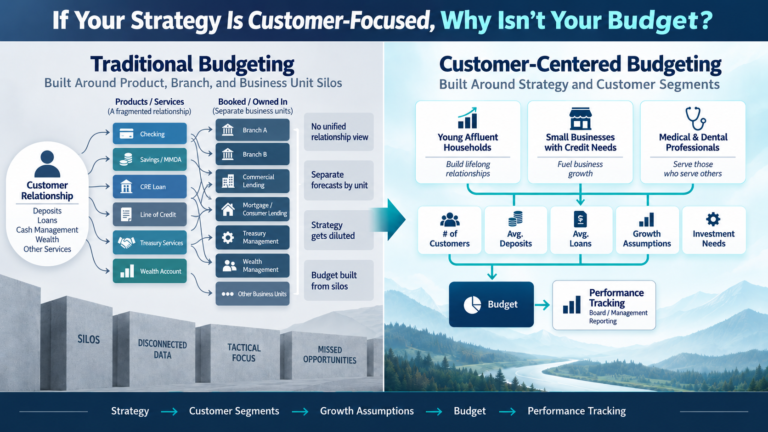
If Your Strategy Is Customer-Focused, Why Isn’t Your Budget?
It’s that time of year again. Banks and credit unions are beginning work on their 2027 operating budgets. The process can be painful. But there’s a bigger problem: Traditional budgeting often causes strategy to disappear. Most banks manage and budget their balance sheet and P&L through business units, branches, and responsibility centers. That makes sense…
-
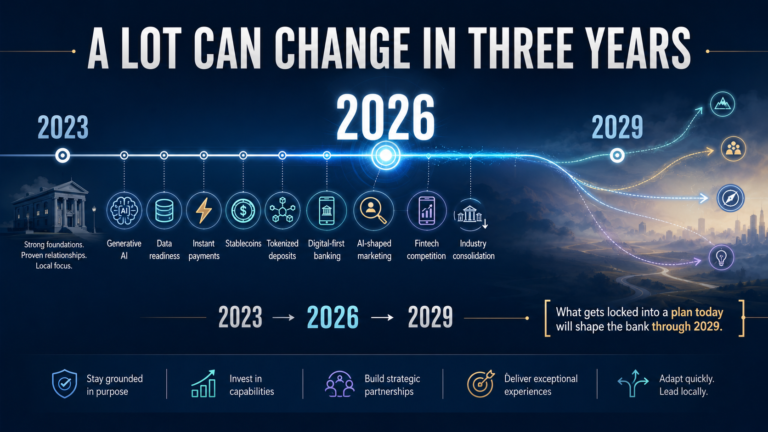
A Lot Can Change in Three Years
In 2023, ChatGPT had just arrived on the scene, and most banks were debating whether employees should even be allowed to use generative AI. FedNow hadn’t launched. Stablecoins lived firmly in the crypto world, not the regulatory one. Three years later, much has changed — and three years happens to be the planning horizon most…
-
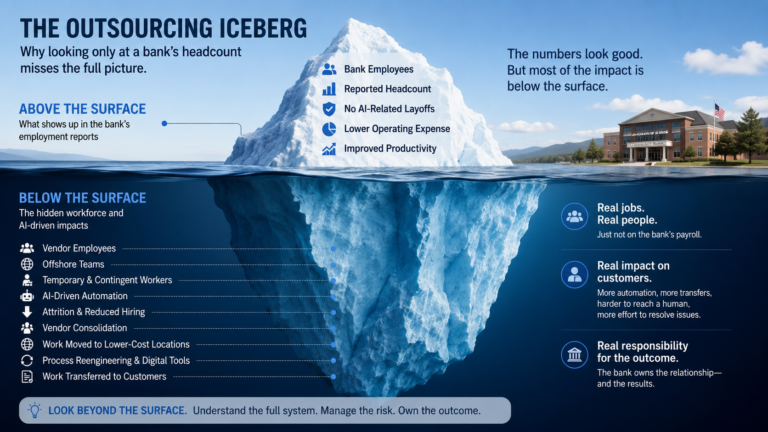
When a Bank Outsources a Function, What Exactly is it Outsourcing?
The obvious answer is the work. But the fuller answer may include the employment relationship, institutional knowledge, customer experience, accountability—and increasingly, the decision about how aggressively to use AI to reduce labor. Community banks have good reasons to outsource. Specialized vendors can provide capabilities, scale, resilience, technology, and expertise that a smaller institution could not…
-
Turning Customer Profitability Information into Action
The following is a real-life case study on the value of customer profitability from my upcoming book: An Executive’s Guide to Customer Profitability. A commercial lender was renewing a real estate loan for a large church when something in the bank’s relationship profitability system caught his attention. The church maintained more than $1.1 million in…
-
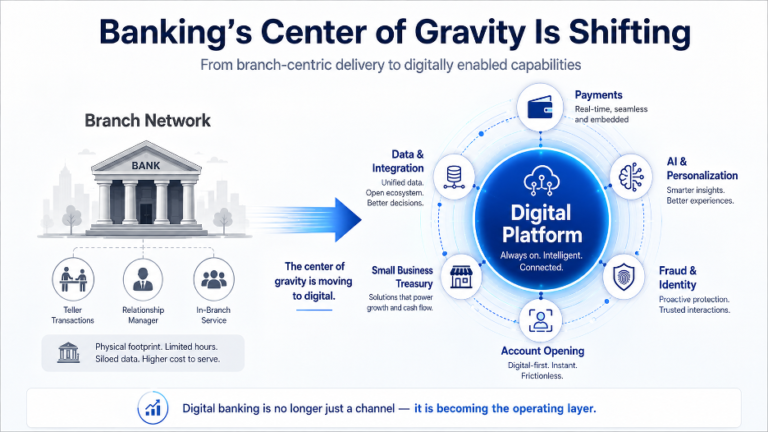
Your Digital Banking Platform is More Than a Technology Decision
It’s a strategic one. And most community banks fail to recognize that. When digital banking first arrived on the scene it was considered an “alternative delivery channel.” Branches were the center of the relationship. Digital was a convenience layer built to handle the basics: Check your balance. Transfer funds. Pay a bill. Deposit a check….
-
Reflections on Two Industry Conferences
I attended two industry conferences in the past three weeks: Alkami Co:lab and Finovate Spring. I came away with the same thought after each event: Most community-bank executives and board members are not getting enough direct exposure to how rapidly banking technology is changing. At Alkami, I saw AI agents that allowed customers to design,…
-
What Would Happen if Your Executive Team was O-O-O for a Month?
I’m not asking the question to challenge the value added by your senior executives. It’s a question related to the resilience of your company based on your organizational structure and values. In other words: if your team was out for a month, would normal decisions continue to be made; problems get surfaced and resolved; and…
-
An Important Thought Experiment
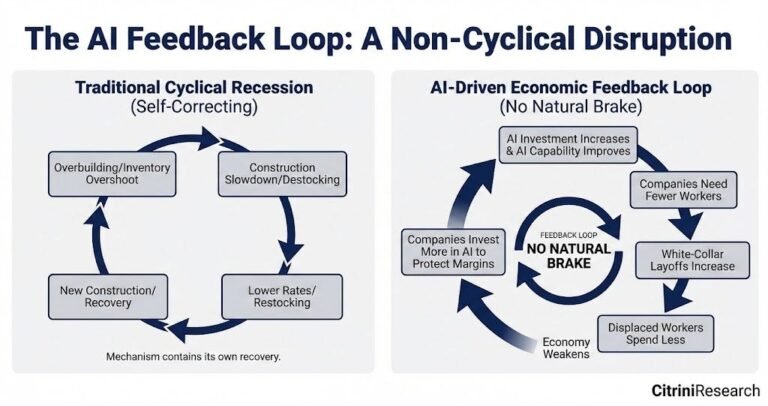
Last week a company called Citrini Research released a paper describing a possible scenario for the global economy in 2028 as artificial intelligence adoption accelerates. The reaction was immediate. Within hours, people on social media were dissecting individual forecasts in the report, debating whether particular numbers were plausible, dismissing others as unrealistic, and in some…
-
Rethinking Human-Computer Interactions
In 1959, Bank of America installed ERMA (Electronic Recording Machine, Accounting), the first large-scale banking computer system. It ushered in a new world. Instead of humans doing all the computational work by hand, computers could now handle that basic data processing. And for the next 60 years, banking technology followed that same pattern: Computers produced…
-
Community Banks Don’t Have the Resources to Address Every Trend. Choose Wisely.
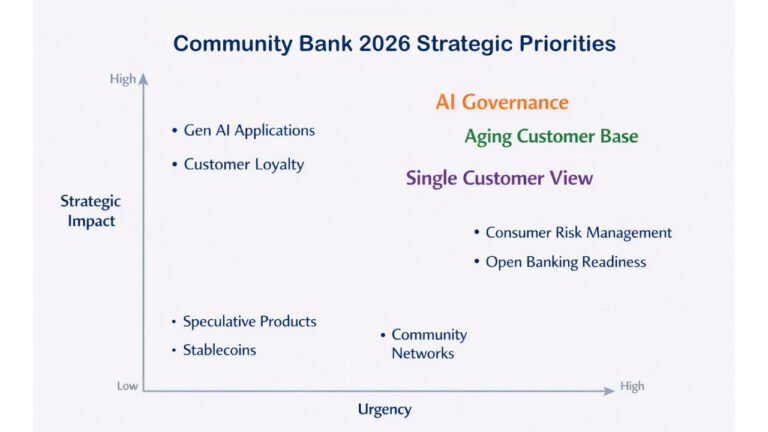
Alex Johnson recently published an excellent article on the forces shaping financial services in 2026. He paired industry predictions with the kinds of resolutions banks and fintechs will need to make in response. The real insight wasn’t the forecasts themselves (though they were all highly relevant), but the discipline of tying resolutions to realities, and…
-
A Banker’s Toolkit: 5 AI Projects to Get You Started
Not sure where to begin with AI? This guide lays out five practical projects—ranging from internal chatbots to cross-sell engines—that any bank can start exploring today. No massive budget or data science team required. Just smart steps toward better efficiency, insight, and customer service.
-
“So … Are We Doing Anything With AI?”
Many bank board members are asking: “Should we be doing something with AI?” The answer is yes—and if management hasn’t brought it up, that’s a red flag. This guide helps directors understand where AI fits in banking, what risks to watch for, and what smart oversight looks like—no tech background required.
-
Business Intelligence for Community Banks – An Agile Guide
Many community banks are data-rich but insight-poor. This post explores how an agile, phased approach to business intelligence can help banks unlock meaningful insights quickly—without massive investments or long timelines.
-
The Payments Puzzle: Smart Moves for Community Banks
Community banks are feeling the pressure to modernize payments—but limited vendor options, high costs, and fraud concerns make the path forward unclear. Let’s unpack those challenges and discuss strategies for staying competitive.
-
Why Mindset Matters —Especially for Your Company
Mindset isn’t just a personal trait—it’s a business strategy. Companies with a growth mindset adapt faster, innovate more, and invest in people. Learn how to spot fixed-mindset traps and take practical steps to build a culture of continuous learning and growth.
-
What Smart Acquirers Do Before Legal Close
Mergers move fast—and if you don’t get the right data early, you risk flying blind. This post explains why smart acquirers push for structured data extracts before legal close, what information to ask for, and how to do it responsibly. From product planning to fair value adjustments, the payoff is huge.
-
“I Managers” vs. “We Managers”
Too many companies stall out not because of poor strategy, but because the wrong people are leading key teams. This post helps CEOs distinguish between two powerful leadership styles—“I Managers” and “We Managers”—and shows how each one impacts culture, innovation, and long-term growth.
-
Helping “I Managers” Grow
Some managers drive performance. Others quietly drain team morale. If you’re serious about building a strong leadership bench, it’s time to identify the “I Managers” in your company and help them grow into team-first leaders. This post walks through how to spot the signs, understand the root causes, and guide those managers toward more collaborative, effective leadership.
-
The Physics of Business Decision-Making
Why do once-thriving companies like Kodak, Blockbuster, and Toys “R” Us fail to adapt to changing markets—while others like Amazon and Netflix reinvent themselves? This post explores how Newton’s laws of motion offer a surprisingly useful lens for understanding business inertia, transformation, and the consequences of action (or inaction). Learn how applying these principles metaphorically can help leaders make smarter, more adaptive decisions.
-
Strategic Plan Scorecard
Too many financial institutions confuse a wish list of vague initiatives with actual strategy. This post offers a practical scorecard to help bank executives and board members evaluate—and improve—their strategic plans. From business models and technology to marketing and culture, it provides 58 focused questions across critical planning categories to ensure your plan is realistic, forward-looking, and actionable.
-
Lessons Learned from a Digital Banking Conversion
After completing a major mobile and online banking system conversion for a multi-billion-dollar credit union, we took a hard look at what worked and what didn’t. From project planning and testing to customer communications and post-launch support, this post shares detailed lessons learned—along with practical tips for financial institutions preparing for their own system conversions.
-
5 Things To Consider As You Complete Your Strategic Plan
As annual planning season wraps up, now’s the time to take a step back and make sure your strategic plan hits the mark. Is it focused on customer needs or internal processes? Does it define a clear future vision and allocate resources wisely? This post offers a checklist to ensure your plan drives real strategic progress—not just paperwork.
-
You Need Actionable Data to Survive
Data is the key to smarter decisions, better customer experiences, and long-term growth. But many banks still struggle with fragmented, hard-to-access information. This post breaks down the core benefits of a modern data warehouse—from integrating siloed systems and improving efficiency to enabling advanced analytics and supporting real-time business intelligence. If your institution hasn’t made data a strategic asset yet, now is the time.
-
The Importance of a Strategic Budget
Operational budgets keep the lights on. Strategic budgets move the company forward. This post explores the key differences between the two—and explains why carving out a dedicated budget for long-term, cross-functional initiatives can help financial institutions stay focused, fund innovation, and actually deliver on their strategic plans.
-
Design Thinking – A Different Approach to Decision Making
Design thinking is a customer-first, iterative approach to solving business problems—especially those tied to digital transformation. Unlike traditional decision-making, it begins with empathy, invites experimentation, and reduces the risk of failure by testing ideas before full-scale rollout. Here’s how it compares to conventional project planning—and why more financial institutions should take note.
-
Digital Transformation and the Board of Directors
Too many bank boards still reflect a bygone era—older, male, and lacking in diversity. That might have worked in the past, but today’s fast-changing world demands leadership that mirrors the communities it serves. In this post, I explore how board composition affects digital innovation, customer engagement, and long-term relevance—and offer practical steps to build a more representative and forward-thinking board.




















Browse by Category