When a Bank Outsources a Function, What Exactly is it Outsourcing?
The obvious answer is the work. But the fuller answer may include the employment relationship, institutional knowledge, customer experience, accountability—and increasingly, the decision about how aggressively to use AI to reduce labor.
Community banks have good reasons to outsource. Specialized vendors can provide capabilities, scale, resilience, technology, and expertise that a smaller institution could not economically maintain on its own. Outsourcing can convert fixed costs into more flexible expenses, accelerate implementation, improve service availability, and let bank employees focus on areas that differentiate the institution.
But the analysis should extend well beyond the vendor’s price. Consider the workforce implications.
An outsourced employee may perform work that is essential to the bank, interact with its customers, use its systems, and represent its brand—while receiving materially different wages, benefits, job security, training, and career opportunities than a bank employee.
This can create a two-tier workforce:
- Bank employees participate in the institution’s culture, benefits, development programs, and internal career paths.
- Contractor employees perform necessary work but may be treated as interchangeable resources whose cost is regularly tested through competitive bidding.
The work remains important. The worker’s relationship to the successful enterprise has changed. This distinction will become even more important as AI adoption accelerates.
Labor-intensive vendors may have stronger incentives than banks themselves to automate aggressively. For a bank, AI may be one of many strategic initiatives. For a contractor operating on thin margins, AI may be essential to winning the next bid, reducing unit costs, and protecting profitability.
That means an analysis of AI’s impact on bank employment can be seriously incomplete if it looks only at employees on the bank’s payroll.
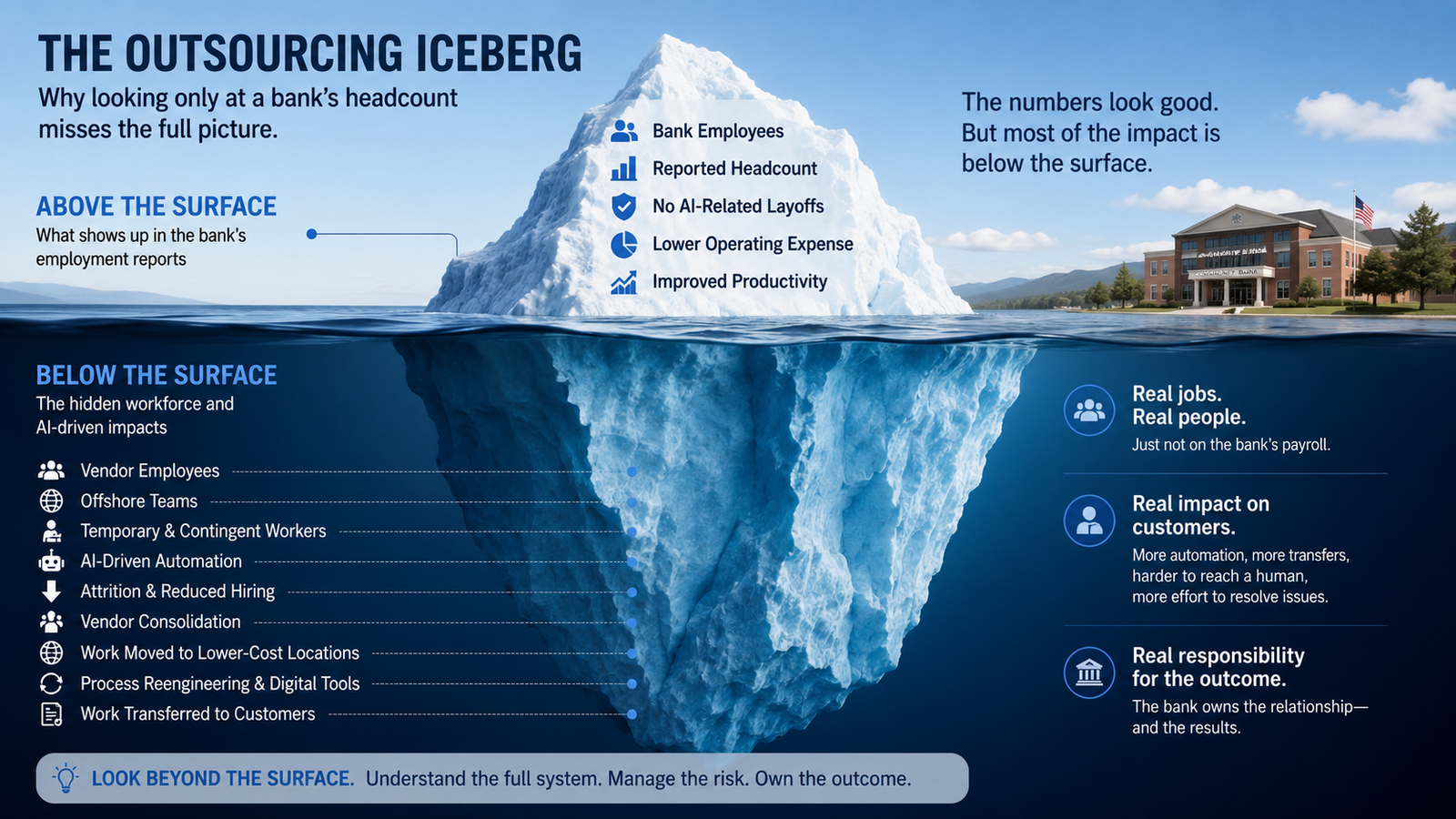
Suppose a bank outsources a 50-person support function. The vendor introduces AI assistants, automated document processing, chatbots, quality monitoring, and increasingly autonomous agents. Over time, the same work requires only 30 people.
The bank may report:
- No AI-related layoffs
- Stable internal employment
- Lower operating expense
- Improved productivity
Yet 20 jobs supporting the bank’s activities have disappeared.
The displacement is economically real even though it occurred on another company’s payroll, through attrition rather than layoffs, or in a location the bank never sees.
Customers also experience both sides of this tradeoff. Outsourcing and AI can deliver meaningful benefits:
- Faster service
- 24-hour availability
- Lower costs
- Greater consistency
- Better fraud detection
- More accessible and personalized interactions
But problems arise when cost reduction removes too much judgment, experience, and accountability from the service model.
Customers may find themselves trapped between a chatbot, a scripted contractor, and a bank employee who no longer owns the process. Routine requests may be handled efficiently, while unusual or consequential problems become nearly impossible to resolve.
The labor has not always disappeared. Sometimes it has been transferred to the customer, who must repeat information, navigate systems, diagnose the problem, and manage the escalation without compensation.
There are also risks involving data privacy, cybersecurity, biased automated decisions, the loss of institutional knowledge, and confusion over who is responsible when something goes wrong.
A bank may outsource the work. It cannot outsource accountability for the outcome.
None of this means outsourcing is inherently wrong or that AI should be resisted. Both can strengthen a community bank when applied thoughtfully.
But a responsible decision should ask more than:
Can a vendor perform this function more cheaply?
It should also ask:
- Where do the savings come from?
- What happens to the people performing the work?
- Will employees of the bank and vendor be treated as two fundamentally different classes of worker?
- How will AI change the vendor’s future staffing model?
- What human expertise and authority must remain available to customers?
- Who owns the problem when the standard process fails?
- Are productivity gains improving the customer proposition—or simply increasing margins?
The appropriate unit of analysis is not just the bank’s legal workforce. It is the bank’s extended workforce: employees, temporary staff, consultants, contractors, offshore teams, and vendor personnel whose labor supports the institution and its customers.
As AI expands, community banks will need a broader definition of both employment impact and operational responsibility.
The central question is not merely whether the bank employs fewer people.
It is whether the total system supporting the bank is becoming more productive without becoming less fair, less accountable, or less human.