An Important Thought Experiment
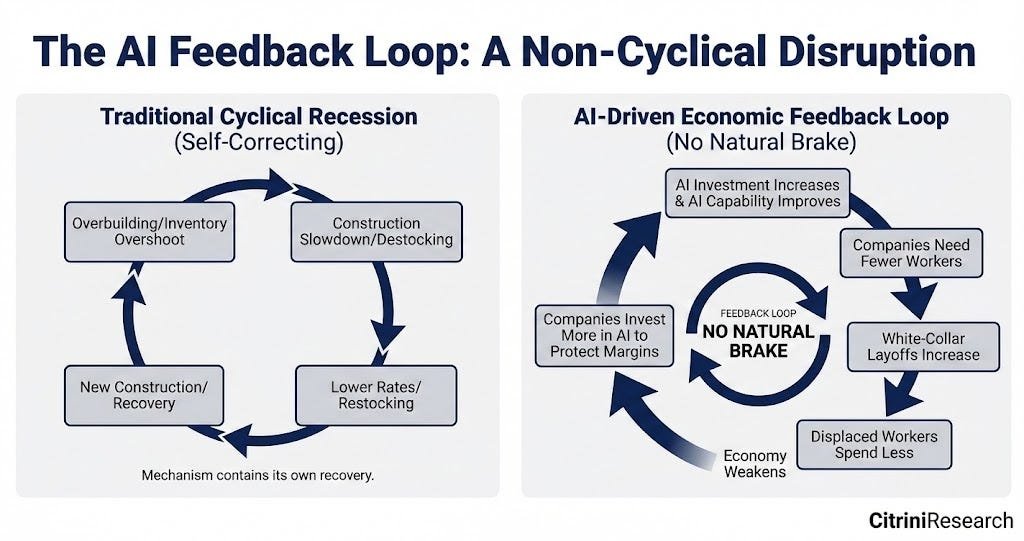
Last week a company called Citrini Research released a paper describing a possible scenario for the global economy in 2028 as artificial intelligence adoption accelerates.
The reaction was immediate. Within hours, people on social media were dissecting individual forecasts in the report, debating whether particular numbers were plausible, dismissing others as unrealistic, and in some cases ridiculing the entire exercise.
And in doing so, I think many people completely missed the point.
The authors made it clear in the preface that their paper was not a prediction. It was a thought experiment.
Scenario analysis has long been used in fields ranging from military planning to energy markets. The purpose is not to say this is what will happen. The purpose is to ask a different question:
What might be the outcome if current trends continue, or even accelerate?
AI may prove to be the most transformative technology in human history. When technologies of that magnitude emerge, the biggest risk isn’t that we imagine too many futures.
It’s that we imagine too few.
Too often, we dismiss uncomfortable scenarios because the details seem unrealistic. But the real value of exercises like this lies in the questions they force us to confront:
- What if productivity accelerates dramatically?
- What if large categories of knowledge work change faster than labor markets can adapt?
- What happens to financial markets when AI systems can analyze and act on information faster than humans?
- How do institutions (businesses, governments, regulators) adapt to that pace of change?
These are not predictions. They are preparation exercises.
In 1972, the U.S. Congress established the Office of Technology Assessment to help policymakers think through exactly these kinds of questions. Its mission was to study emerging technologies and evaluate their potential economic, societal, ethical, and legal consequences.
Unfortunately, the agency was defunded in 1995.
Today we are entering a technological transition that will dwarf anything the OTA ever studied, and yet our collective capacity to systematically think through those consequences is actually much weaker.
Instead, we rely on markets, venture capital, and technological optimism to propel us forward. The assumption (or hope?) seems to be that we will figure things out along the way.
More than a century ago, Albert Einstein wrote:
“Technological progress is like an axe in the hands of a pathological criminal.”
The quote is often interpreted as a warning about the misuse of technology. But it might also be read another way.
Technology amplifies human capability.
Which means the question we should be asking is not simply what AI can do.
It is whether we are thinking deeply enough about what happens when it does.
That is why thought experiments like the Citrini report matter.
Not because they will be right.
But because the future rarely arrives in ways we expect. And the time to start thinking about it is now.