Rethinking Human-Computer Interactions
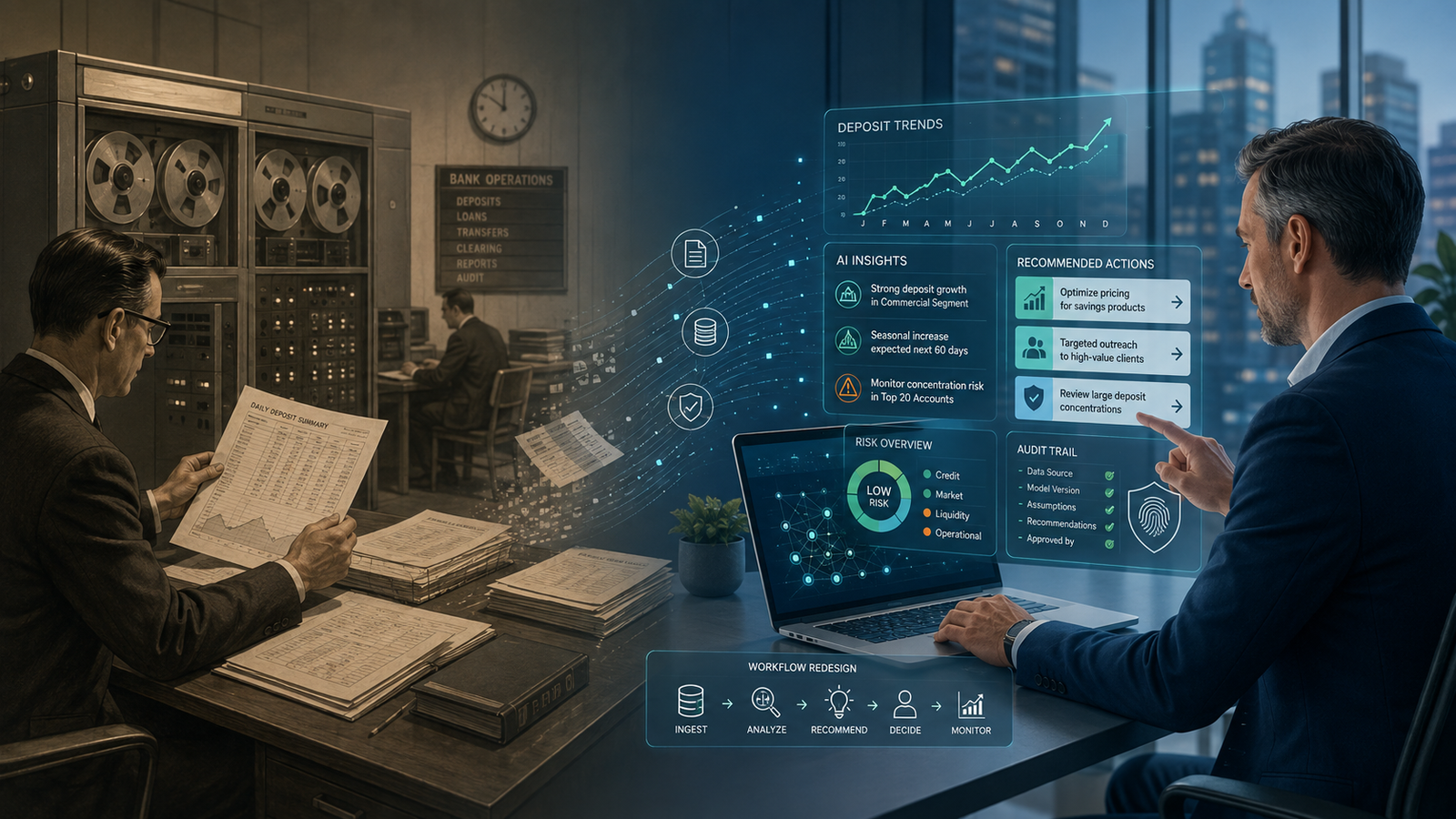
In 1959, Bank of America installed ERMA (Electronic Recording Machine, Accounting), the first large-scale banking computer system. It ushered in a new world. Instead of humans doing all the computational work by hand, computers could now handle that basic data processing.
And for the next 60 years, banking technology followed that same pattern:
- Computers produced reports.
- Humans interpreted them.
- Humans decided what to do.
But generative AI changes the interaction itself. Computers no longer just present data—they interpret it.
Instead of reviewing ten dashboards, an executive can ask:
“What trends are most likely to hurt our deposit base?”
Instead of a branch manager reviewing an overdraft list, an AI agent can recommend pay/no-pay decisions based on policy, history, and customer behavior—with a full audit trail.
This is why a true data culture isn’t about more dashboards. It’s about redesigning how humans and computers work together.
From data presentation → to machine interpretation
From reports → to recommendations
From human-in-the-loop → to human-on-the-loop
Banks that understand this shift will redesign processes.
Banks that don’t will just automate reports.
Which approach do you think will drive sustainable productivity gains?