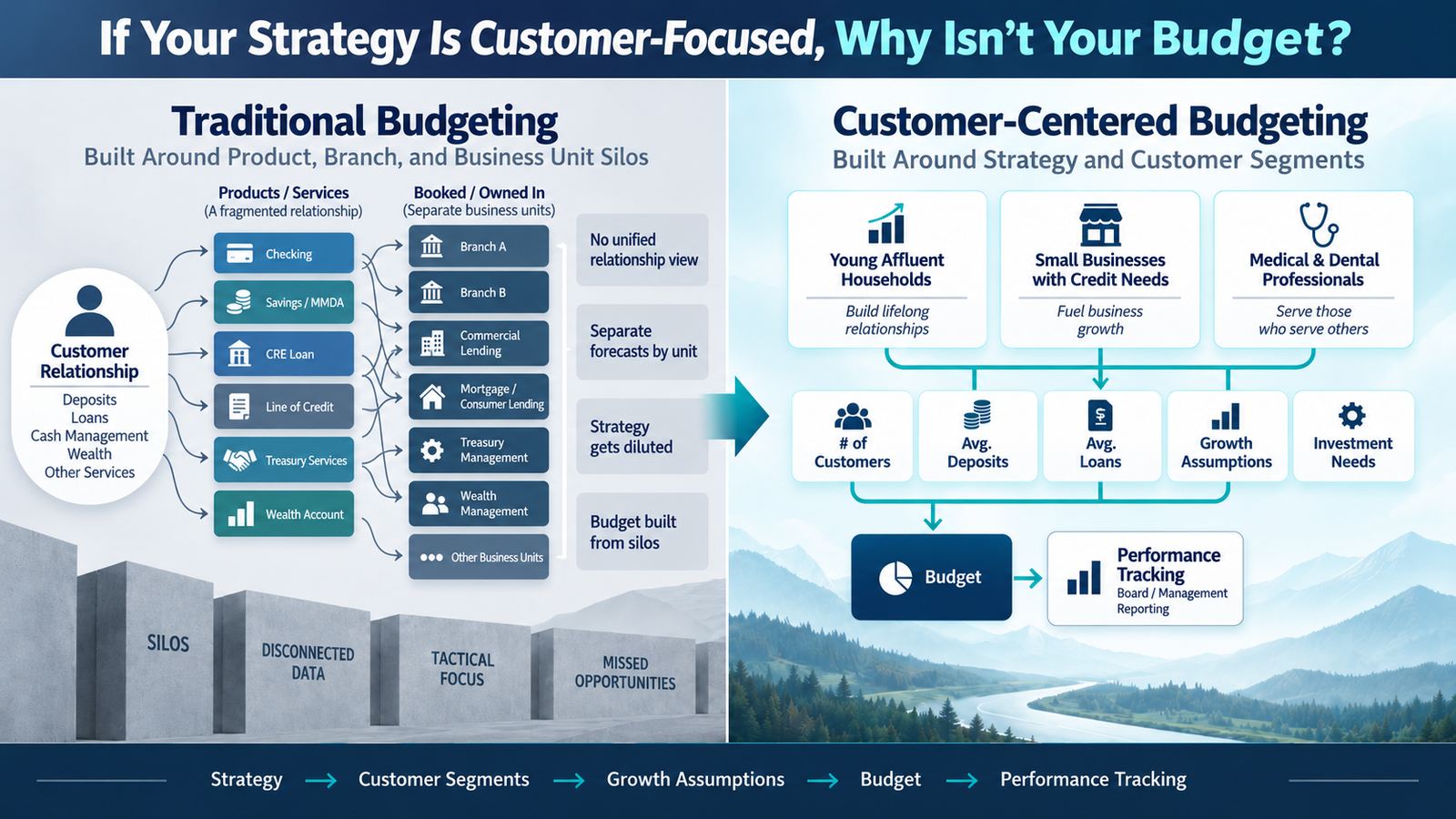
If Your Strategy Is Customer-Focused, Why Isn’t Your Budget?
It’s that time of year again. Banks and credit unions are beginning work on their 2027 operating budgets.
The process can be painful. But there’s a bigger problem:
Traditional budgeting often causes strategy to disappear.
Most banks manage and budget their balance sheet and P&L through business units, branches, and responsibility centers. That makes sense from an accounting standpoint.
But that approach also chops customer relationships into unrecognizable pieces.
One customer may have deposits booked at multiple branches, a mortgage somewhere else, and a small business loan assigned to a lending unit. Each responsibility center only sees – and budgets – its piece of the relationship.
The result is a budget built around accounts and organizational structures rather than customers and strategic priorities.
That creates an odd disconnect.
Your strategic planning process may have spent considerable time identifying the customer segments you want to serve, their needs, your value proposition, and the opportunities for growth.
Then budget season arrives, and the organization goes back to asking:
- How much will this branch grow?
- What will commercial loans do next year?
- How much will deposits increase?
Those are questions that ultimately need to be answered. But they skip an important step.
Start with the customers.
Suppose your strategic priorities include serving customer segments such as:
- Mass-affluent consumers under 40
- Small businesses with credit needs
- Medical and dental professionals
For each segment, first develop a historical relationship-level view showing things such as:
- Number of customers
- Total loans
- Total deposits
- Average loan balance per customer
- Average deposit balance per customer
Then ask the questions that connect strategy to financial performance:
- How many customers do we expect to gain?
- How much of their financial relationship do we expect to capture?
- What products, services, and experiences will they need?
- What investments will we have to make to win and retain those relationships?
Now the growth assumptions become much more tangible.
Instead of simply budgeting, for example, 6% deposit growth, management must explain where that growth will come from:
- More customers?
- Higher average balances from existing customers?
- Both?
From those assumptions, you can project customer counts and average loan and deposit balances by segment, calculate total relationship balances, and aggregate the results into a bank-wide forecast.
And this does not mean abandoning your existing budgeting system.
Once the customer-segment projections are complete, they can be disaggregated back into branches, business units, products, and general ledger accounts to support the traditional budget.
The difference is where you start.
You start with strategy and customers, then translate the result into the accounting structure—not the other way around.
And there is another benefit.
Preserve the segment-level projections and report actual results against them throughout the year. They can become part of the monthly management and Board reporting package, providing a direct measure of whether the bank is actually executing the customer strategy it agreed upon during strategic planning.
That creates a much stronger connection:
Strategy → Customer Segments → Growth Assumptions → Investment → Budget → Performance Measurement
The traditional budget still has an important role.
But if your strategy says growth will come from particular customer relationships, your budget should tell you how many of those relationships you expect to build, how deep you expect them to become, and what it will cost to make that happen.
Strategy should drive the budget—not disappear when budgeting begins.
Could your bank produce those customer relationship views today?
If not, let’s talk.