Turning Customer Profitability Information into Action
The following is a real-life case study on the value of customer profitability from my upcoming book: An Executive’s Guide to Customer Profitability.
A commercial lender was renewing a real estate loan for a large church when something in the bank’s relationship profitability system caught his attention.
The church maintained more than $1.1 million in average collected balances in a non-interest-bearing checking account. Yet the profitability system showed the deposit relationship was highly unprofitable.
At first glance, that made little sense. A large, non-interest-bearing deposit should have been extremely valuable to the bank.
This occurred at a $15 billion commercial bank where I had developed a customer profitability system and integrated relationship-pricing model. The system was available to employees through the bank’s intranet, and all new loans and loan modifications were required to be analyzed as part of the credit approval process. Profitability was evaluated both for the individual transaction and for its impact on the customer’s total relationship with the bank.
When I pulled up the church’s relationship, the problem quickly became apparent.
The operating account had been placed in a business checking product designed primarily for smaller businesses rather than in an analyzed commercial account. More importantly, the profitability system showed exactly what was driving the losses.
Church employees were visiting the branch virtually every business day, sometimes more than once a day, to make deposits and conduct other transactions. They were therefore making intensive use of one of the bank’s most expensive servicing channels.
The church was also writing a large volume of checks, generating significant processing costs. All service charges on the account had been waived. The bank was even paying for the church’s check printing, at a cost of more than $900 per year.
Taken together, the cost of servicing the account exceeded the transfer-priced value of the $1.1 million in deposits. Despite its large balance and lack of interest expense, the account was destroying value.
Fortunately, the manager of the branch that held the operating account was one of the bank’s most proactive managers. When I explained what we had found, her response was simple:
“I’m on it.”
She contacted the customer and explained that the account would be moved to an analyzed commercial account. More importantly, she arranged a meeting with representatives from Treasury Management to look at how the bank could improve the way the church handled its day-to-day banking.
Within a month, a very different relationship was in place.
The bank installed remote deposit capture so checks could be deposited from the church office. The church was given online ACH and wire-origination capabilities and was enrolled in both check and ACH positive pay. A smart safe was installed so cash could be deposited securely at the church while receiving immediate credit.
The blanket service-charge waivers were also eliminated. Instead, the cost of banking services was incorporated into the church’s account analysis and offset against the earnings value of its deposit balances.
The review also uncovered opportunities beyond the original deposit account. The church began using the bank’s payroll-processing partner and established a merchant-processing relationship, including card readers that could be used for transactions with parishioners.
The result was not simply higher fees.
The economics of the relationship changed because the way the customer used the bank changed.
Remote deposit capture and the smart safe sharply reduced the need for church employees to visit the branch, lowering servicing costs. Electronic payments reduced reliance on checks. Appropriate account analysis allowed the bank to recover the cost of services being provided. Payroll and merchant processing generated additional relationship revenue.
At the same time, the customer received a better banking experience. Employees no longer needed to make frequent trips to the branch or transport large amounts of cash. Electronic payments were easier to initiate, and positive pay provided additional protection against fraud.
Within two months, the church’s operating account went from generating a significant loss to producing a solid net profit.
The Larger Lesson
The most important lesson from this case is not simply that an unprofitable account was made profitable.
It is that no individual business unit had enough information to recognize the problem—or the opportunity—on its own.
The commercial lending center saw a profitable loan relationship.
The branch saw a large deposit account and a customer that generated substantial transaction activity.
Treasury Management had products that could make the customer’s banking more efficient, but there was no obvious reason for it to become involved.
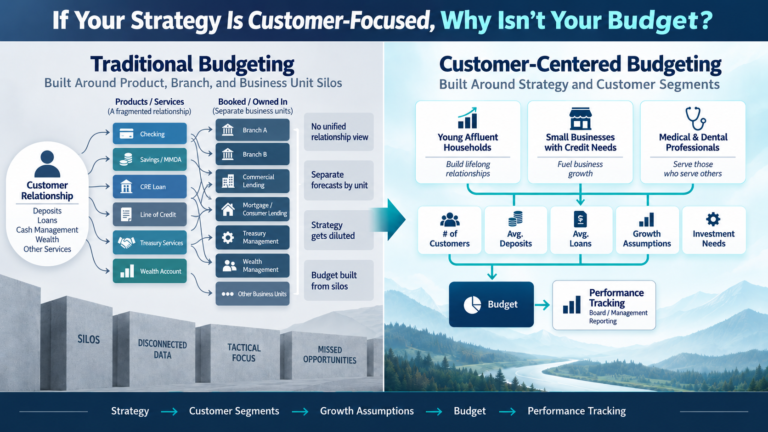
Traditional bank reporting tends to reinforce these organizational silos. Lending reports focus on loans. Deposit reports focus on balances and fees. Branch reports focus on revenue and expense. Product systems report what is happening within their individual areas.
A relationship profitability system can do something fundamentally different: bring the relevant information together at the customer level and show the economics of the entire relationship.
In this case, all of the underlying information already existed somewhere inside the bank. The profitability system did not create the $1.1 million deposit balance, the branch transactions, the waived fees, the loan relationship, or the Treasury Management opportunities.
Its value came from connecting those facts in a way that made the problem visible and prompted people to act.
That action created a better outcome for everyone involved: a more profitable relationship for the bank and a safer, more convenient banking experience for the customer.
That is the real value of customer profitability information: not better reports, but better decisions.